
youtube.com/@thinkschoolSept 2026
Start a Business With No Money | Eric Ries’ Guide for First-Time Founders
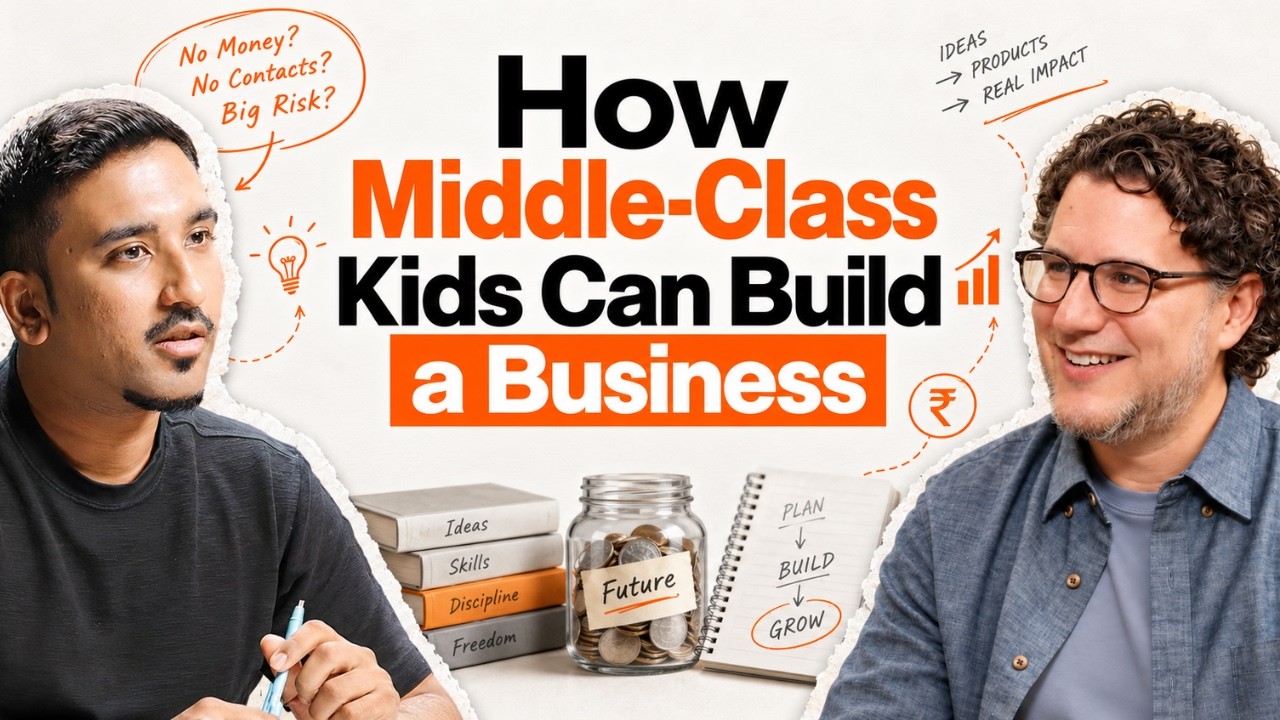
youtube.com/@thinkschool
12 Sept 2026 · Startups
66 min watch → 3 min
Eric Ries lays out how first-time founders can start with little money by testing assumptions, measuring real customer behavior, and using engines of growth to judge product-market fit. The discussion covers MVPs, metrics, hiring, trust, and differentiation.
Lean Startup Method
Run a startup as a build, measure, learn loop: build a simple version, measure real customer behavior, learn from data, spend only on making this loop faster
Test whether customers will actually buy, not whether friends say the product sounds good, because a startup idea is a hypothesis made of assumptions
2 / 20
A first-time founder can start with less than $1,000 by renting tools, using AI software, and testing demand before building
Lack of capital can force better decisions than raising money too early
3 / 20
Dropbox validated demand before building the product by releasing a 3-minute screen-recorded demo and collecting 75,000 waitlist signups overnight
4 / 20
To test a consumer product such as coffee, the first question is whether anyone will buy even one cup over existing alternatives such as Starbucks
Not how to build a factory
5 / 20
A minimum viable product can test the real source of differentiation, because what makes a consumer brand win may be mission, design, or quirkiness rather than the founder's original assumption
6 / 20
Tony's Chocolonely validated demand before full production by announcing 5,000 fair-trade chocolate bars and selling 15,000 before the bars even existed
7 / 20
Customer conversations are useful for discovery, generating ideas and hypotheses, but validation requires experiments that measure behavior
Customers often say they would pay and then do not pay
8 / 20
Product-market fit, the state where a product is pulled strongly by real demand, feels like a tornado
Judge progress with per-customer metrics such as repeat purchase, retention, margin, customer acquisition cost, and lifetime value, not vanity metrics like downloads or total users
9 / 20
Track growth metrics instead of vanity metrics for a direct-to-consumer brand
1
Monthly active users instead of app downloads2
Repeat rate instead of registered users3
Conversion per post instead of Instagram followers4
Profit per store instead of store count10 / 20
Dropbox paid acquisition
$233 to $388
Cost to acquire a customer who paid only $99 per year
Dropbox learned that paid acquisition would not scale
11 / 20
Sustainable growth comes from past customers causing new customers to arrive, and this happens through three engines of growth
Paid growth driven by marginal profit per customer, viral growth driven by a K-factor above 1, and sticky growth driven by low net churn and strong retention
12 / 20
In a paid engine of growth, the key variable is marginal profit per customer
A product sold for $100 that costs $50 to make can fund one new customer for every two sales, while negative marginal profit causes shrinkage
13 / 20
In a viral engine of growth, the key variable is the K-factor, where a K-factor above 1 creates compounding growth and a K-factor below 1 causes the product to fade out
14 / 20
In a sticky engine of growth, repeat purchase and retention matter most, and a useful test is whether customers remember to use the product on their own or need reminders
15 / 20
Selling through marketplaces such as Amazon can hide repeat purchase and churn, so brands need a direct relationship with customers
Improve the direct buying experience instead of treating the business as only selling units
16 / 20
Trust can be a competitive advantage when a company acts as a fiduciary to the customer, putting customer interests first even when costly in the short term
17 / 20
Costco hot dog combo
$1.50
Price held constant since 1986, selling about 200 million per year to reinforce customer trust rather than maximize short-term profit
18 / 20
A real unique value proposition is a promise that competitors cannot honestly make
Such as Tony's Chocolonely's anti-child-slavery mission, Patagonia's environmental honesty, or Costco's customer-first pricing discipline
19 / 20
Read the full source
Start a Business With No Money | Eric Ries’ Guide for First-Time Founders
youtube.com
Think School
20 / 20
Carouse
Turn any article, video, or podcast into a carousel you can browse in 30 seconds.