
youtube.com/@ycrootaccessSept 2014
Lecture 1 - How to Start a Startup (Sam Altman, Dustin Moskovitz)
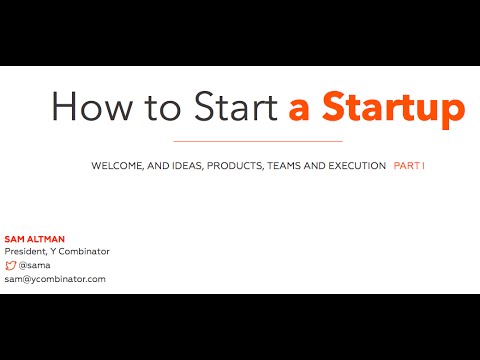
youtube.com/@ycrootaccess
23 Sept 2014 · Startups
44 min watch → 80 sec
The lecture lays out the core conditions for startup success: a strong idea, a product users love, a capable team, and strong execution. It also argues that founders should start companies only when they feel compelled by a mission and a timely market opportunity.
A hypergrowth startup succeeds mainly through four factors, a great idea, a great product, a great team, and great execution. Luck still matters a lot.
The first job is to build something a small number of users love, and the best ideas usually start small, unpopular, and narrow.
2 / 18
Start a company only if you feel compelled to solve one specific problem.
Mission sustains the decade of effort, focus, and recruiting.
3 / 18
Starting a startup is less glamorous and less flexible than most people expect.
Do it because the problem matters and you are suited to solve it.
4 / 18
10x
Execution matters more than the idea.
Execution is also 100 times harder. Bad ideas still fail.
5 / 18
A startup idea includes more than the product.
1
Market size matters.
2
Market growth matters.
3
Growth strategy matters.
4
Defensibility makes replication hard.
6 / 18
A strong startup idea answers, "Why now?"
It could not work two years earlier, and waiting two years would be too late.
7 / 18
Choose a rapidly growing market over a large slow-growing market.
Founders usually cannot create demand for a market that does not want to exist.
8 / 18
Students often spot fast-growing new markets early.
They understand new technology and changing user behavior better than older investors or operators.
9 / 18
The best startup ideas usually sound bad at first.
They start small, win a narrow market, then grow with a much bigger future market.
10 / 18
Most successful pivots move toward something the founders personally needed.
Airbnb began with Brian Chesky needing rent money and having extra space.
11 / 18
If you are not building something you need, get extremely close to customers.
Work in their office or talk to them multiple times a day.
12 / 18
Good startup ideas are usually easy to explain in one sentence.
Clone ideas like "X with beautiful design" usually fail.
13 / 18
Build something a small number of users love, not something many users merely like.
Deep enthusiasm spreads. Weak enthusiasm rarely becomes love later.
14 / 18
Recruit early users manually, not through ads.
Ben Silbermann personally recruited early Pinterest users for feedback and advocacy.
15 / 18
A startup's early loop is simple.
1
Build the product.
2
Talk to users.
3
Change the product.
4
Measure retention and active use.
5
Track revenue and net promoter score.
16 / 18
Ignore most early distractions.
1
Ignore PR.
2
Ignore conferences.
3
Ignore advisers.
4
Ignore partnerships.
5
Protect your health.
17 / 18
Read the full source
Lecture 1 - How to Start a Startup (Sam Altman, Dustin Moskovitz)
youtube.com
YC Root Access
18 / 18
Carouse
Turn any article, video, or podcast into a carousel you can browse in 30 seconds.