Startups
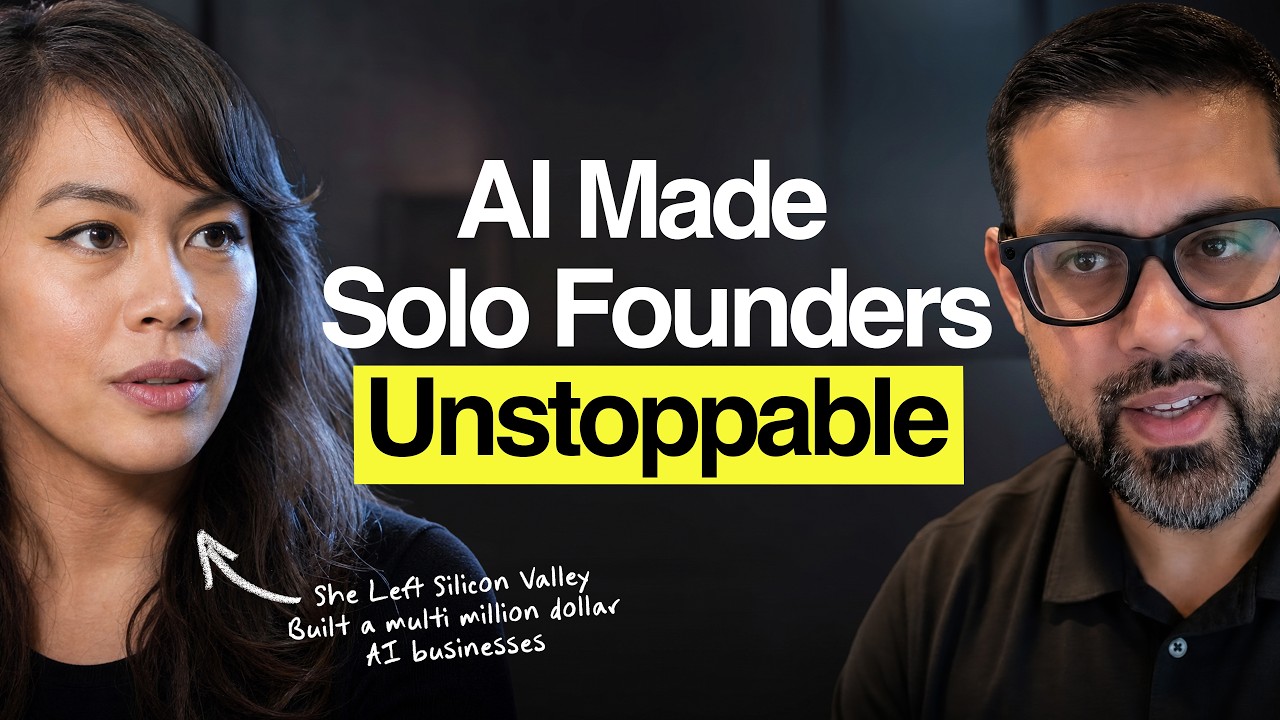
She Built Two AI Businesses Solo, Here's the exact System

youtube.com/@productfaculty
23 Aug 2026 · Startups
46 min watch → 3.5 min
A solo founder describes how she validated an AI software idea, launched a minimal product, used audience-driven distribution, and grew from zero to millions in annual recurring revenue with heavy use of AI tools and automation.
Solo founder playbook
AI tools let a solo founder with product or technical skill build and run a multi-million-dollar software business without raising capital or hiring a team first
The fastest path is to solve your own problem, test demand with audience feedback, and launch a minimal viable product, a stripped-down first version, before adding features
02 / 20
A personal brand or distribution channel, an audience that already trusts your expertise, acts as a cheat code for customer acquisition
It sends a constant flow of new users and feedback for product improvement
03 / 20
Vibe coding, using AI to generate much of the first version of a product, is best for validating an idea and getting the first 10 to 100 paying customers
It is not for replacing engineering judgment in a mature product
04 / 20
Bootstrapping a small software business to $1 million to $2 million a year creates cash flow and optionality
You can stay independent or raise funding later if you want to grow bigger
05 / 20
The product idea came from a real workflow pain point, repurposing one piece of content across platforms
Repeated audience comments asked for an app instead of fragile make.com automations
06 / 20
Demand validation started with a 30-second TikTok posted on August 1, 2024, asking whether people wanted a software-as-a-service tool that could repurpose content and automate social posting
The tool was aimed at small businesses
07 / 20
Comments and survey responses were not enough to trust, so direct phone calls with 10 to 20 commenters were used to learn what tools people already used and what they paid for
The calls revealed where the new product would fit in their workflow
08 / 20
The first product version succeeded because it was aggressively pruned, for example generating only a Facebook post instead of supporting LinkedIn, Twitter, and Facebook at once
That basic version still reached the first $10,000 in monthly recurring revenue
09 / 20
Launch velocity
10 days
Time from launch on October 20 to reaching the first $10,000 in monthly recurring revenue
An existing audience and a waitlist with hundreds of interested people accelerated growth
10 / 20
An early adopter program with about 50 selected users slowed progress because self-reported use cases did not match actual behavior
PostHog session recordings confirmed this say-do gap
11 / 20
Watching user session recordings was the most useful early product research because it showed where people rage-clicked, got stuck in payments, and failed onboarding
This happened before formal dashboards or funnels were set up
12 / 20
Changing onboarding from a blank interface to a step-by-step flow improved activation because users reached value faster
01
Paste a link to your content
02
Choose up to five platforms
03
Get draft posts immediately
04
Users see value before exploring settings
13 / 20
Early churn reality
Over 30%
Estimated early churn rate, but constant new signups from existing distribution made it possible to keep improving onboarding and activation
Growth did not stop, so the team could iterate instead of panicking
14 / 20
AI-generated code still requires a human architect because unchecked code can introduce spaghetti code, break production systems, and make hidden changes
The workflow shifts from 100% vibe coding to AI-assisted coding with human specs and review
15 / 20
Building an MVP used to cost about $5,000 to $15,000 and take three to six months, but AI compressed both time and cost
The MVP took less time to build than the YouTube videos documenting it
16 / 20
TikTok was recommended as the best starting platform for new creators because it is unusually generous to new accounts
Posting once a day for 3 to 4 weeks, then 3 times a day, led to the first viral growth after about 6 weeks
17 / 20
The most reliable content strategy was to copy proven hooks and post structures from top-performing creators in the same niche
The opener determines whether people stop scrolling
18 / 20
Content creation was systematized into one day a week, with one long-form video and about 20 short videos
That schedule supported growth from zero to $2 million before adding a second day to reach $3 million
19 / 20
Read the full source
She Built Two AI Businesses Solo, Here's the exact System
youtube.com
Product Faculty
20 / 20
Carouse
Turn any article, video, or podcast into a carousel you can browse in 30 seconds.