Most founders treat product-market fit as the win. It is the starting line. Startups with strong channel and pricing fit grow two to three times more efficiently, and founders who stall after PMF usually mistake a distribution or pricing failure for a product one. This collection walks the arc, what PMF actually is, how to know you have it, and the go-to-market, pricing, and model work that decides whether it turns into a company.
Product-market fit is the milestone every founder chases, and the one most misread once they reach it. The pattern across these talks is consistent: making something people want is necessary, but a startup still dies if go-to-market, pricing, and the business model never catch up. Below is the arc as carousels, core claims first, with a link to the full talk under each.
First, what fit actually means
Product-market fit is the move from an idea to real traction: making something a lot of people want, not something a few users like. David Rusenko on why it takes longer than founders expect, and why you stay lean until repeat usage, not vanity metrics, shows up.
David Rusenko - How To Find Product Market Fit
youtube.com/@ycombinator
5 Sept 2018 · Startups
59 min watch → 1.5 min
Product-market fit comes from repeated customer learning, fast prototyping, and tracking return usage rather than vanity metrics. The path usually takes longer than expected, so founders should stay lean until real traction appears.
Product-market fit is the move from an idea to real traction, and it means making something a lot of people want, not something a few users like.
Finding product-market fit usually takes many iterations. Keep burn low and the team small until strong returning usage, NPS above about 50, and high renewals show real demand.
02 — 19
Product-market fit usually takes far more iterations than founders expect.
The search often takes 20–30 iterations before clear traction appears.
03 — 19
20 months
Weebly took about 20 months to reach clear traction.
New users per day were still declining at 18 months, then turned upward around October 2007.
04 — 19
Press spikes are not product-market fit.
TechCrunch, Newsweek, or Time can lift signups briefly, while usage later falls back and the baseline keeps declining.
05 — 19
The best startups often create a new market by solving a hidden need.
Research on existing categories cannot fully measure demand for a category that does not exist yet.
06 — 19
A new-market startup often looks stupid to outsiders before it looks inevitable.
If the opportunity were obvious, many companies would already be pursuing it.
07 — 19
Customer interviews should uncover demand, not collect feature ideas.
01
Ask what pain people feel.
02
Ask what job they are trying to get done.
03
Do not ask customers to design the solution.
08 — 19
Users can reveal the real demand by pulling a product in an unexpected direction.
When customers hack a product for another job, that behavior can show what to double down on.
09 — 19
A functional prototype is a faster, cheaper test than a fully built product.
Do not optimize for scale early, because millions of immediate users usually never arrive.
10 — 19
UX testing can expose major mistakes with only 3–5 users.
01
Give one task.
02
Stay silent.
03
Watch where confusion appears.
11 — 19
Weebly learned that 'email address' and 'password' looked like a login form.
Adding a third field, 'your name,' made users recognize it as signup.
12 — 19
A better launch bar is a minimum remarkable product.
Ship the smallest product that is clearly better than alternatives in a way users notice.
13 — 19
Prioritization should optimize for learning, not only effort versus impact.
Answering the biggest unknown can rewrite the whole roadmap.
14 — 19
Early product-market fit signals come from retention, not top-line growth.
01
Returning usage stays strong.
02
Net Promoter Score rises above about 50.
03
Paying customers renew at high rates.
04
Signups alone are weak evidence.
15 — 19
Do not scale past about 20 people before product-market fit.
Around 23–25 employees, management layers usually appear and slow direct customer learning.
16 — 19
After product-market fit, scale aggressively but thoughtfully.
The number one player compounds advantages, but growing more than 2x in a year can create a fragile organization.
17 — 19
A startup gets much stronger when product, channel, and business model fit together.
The product beats alternatives, customer acquisition scales, and pricing works without killing growth.
Retention is the test. A product whose retention curve flattens above zero has fit; a curve that decays to zero does not. Alex Schultz, who ran Facebook’s growth, on the North Star metric, the magic moment, and why retention is the foundation everything else compounds on.
Lecture 6 - Growth (Alex Schultz)
youtube.com/@ycrootaccess
9 Oct 2014 · Product
47 min watch → 95 sec
Growth comes from retention, not tactics alone. The key levers are a retention curve that flattens above zero, a clear North Star metric, a fast path to the product's magic moment, and disciplined use of channels like virality, SEO, and notifications.
Retention drives growth. A product whose retention curve flattens above zero has product-market fit, and a curve that falls to zero does not.
Do not build a separate growth team before product-market fit. One North Star metric and one magic moment align growth around durable value.
2 / 20
A retention curve shows what share of one signup cohort still uses the product over time.
If the curve flattens above zero, some users keep coming back.
3 / 20
10,000
customers can be enough to estimate a cohort retention curve.
Check each day what percentage are still monthly active.
4 / 20
Good retention depends on category.
E-commerce can work at 20% to 30% monthly retention. Social usually needs around 80% early retention.
5 / 20
Do not add virality, paid acquisition, or growth hiring before product-market fit.
If users do not stay, those tactics only accelerate churn.
6 / 20
A North Star metric is one company-wide measure of durable value.
Examples include monthly active users, sends, nights booked, and gross merchandise volume.
7 / 20
A North Star metric improves decisions by rewarding long-term activity or transactions.
It prevents teams from optimizing for registrations or reported revenue.
8 / 20
A magic moment is the first product experience that makes the value obvious.
Growth improves when more users reach that moment quickly.
9 / 20
Growth tactics should remove barriers to the magic moment.
1
Show Facebook users their friends quickly.
2
Show eBay users the collectible they want.
3
Show Airbnb users a compelling place to book.
10 / 20
20%
confirmed registrations fell after eBay changed affiliate payouts.
Activated confirmed registered users fell only about 5%, then accelerated.
11 / 20
The eBay affiliate change worked because affiliates sent searchers to relevant item pages.
Users saw what they wanted before being asked to register.
12 / 20
Virality has three parts.
1
Payload is how many people each share reaches.
2
Frequency is how often users send it.
3
Conversion rate is how often recipients sign up or act.
13 / 20
Hotmail grew because every email carried a signup link.
That created high frequency and high conversion, despite low payload per message.
14 / 20
A viral loop matters only after retention works.
Even K-factor above 1 fails if new users quickly churn.
15 / 20
12 hours
Facebook's community translation system took to translate French.
It eventually supported 104 languages, 70 translated by the community.
16 / 20
Keyword research comes before search engine optimization.
In the UK, users searched 'cocktail recipes', not 'cocktail making'. In the US, 'drink recipes'.
17 / 20
100x
SEO traffic increase after Facebook added a directory to public profiles.
Google could reach pages directly instead of through buried navigation.
18 / 20
Email, SMS, and push notifications work only when deliverable and relevant.
Triggered messages tied to meaningful events beat generic newsletters and protect channel access.
This is the thesis. Product-market fit is necessary, not sufficient. A startup also needs go-to-market fit, pricing, and a model that scales sales and deployment. The path from MVP to scale runs through a narrow first segment, low-friction adoption, clear pricing, and fast time to value, not just a product people like.
How to Build a Product that Scales into a Company
youtube.com/@harvardilab
5 Apr 2023 · Startups
65 min watch → 1.5 min
Building a company requires more than a product customers like. The path from MVP to scale depends on a narrow first segment, low-friction adoption, clear pricing, fast time to value, and partnerships or channels that make distribution repeatable.
Product-market fit is necessary, not sufficient. A startup also needs go-to-market fit, pricing, and a business model that scales sales and deployment.
The product-company gap is the distance between a working product and an efficiently growing company. Start with a minimum viable segment, then expand.
02 / 20
A minimum viable product is worth building only after the value proposition is validated.
Viable means buildable and usable, not proven customers will pay.
03 / 20
A value proposition is stronger when the problem is one of four Us.
01
It is unworkable.
02
It is unavoidable.
03
It is urgent.
04
It is underserved.
04 / 20
A solution is stronger when it has one of three Ds.
01
It is discontinuous.
02
It is defensible.
03
It is disruptive.
05 / 20
A minimum viable segment is a narrow customer group with similar pain, budget, use case, and buying channel.
Prove repeatable sales there before expanding.
06 / 20
The right minimum viable segment is small enough that a startup could plausibly dominate it.
Ignore adjacent segments until repeatable sales are proven.
07 / 20
Direct customer research should shape the segment before heavy product investment.
Talk to around 200 prospects. Test pain, willingness to pay, and buying behavior.
08 / 20
Aploy stalled serving nurses, doctors, skilled nursing, home healthcare, senior centers, and veterinary care at once.
Growth accelerated after focusing on hiring nurses first.
09 / 20
Go-to-market fit can be designed with SLIP.
01
Simple to install and use.
02
Low initial cost.
03
Instant and ongoing value.
04
Plays well in the ecosystem.
10 / 20
Simple onboarding matters because complexity raises adoption friction.
Early products should solve one or two critical problems extremely well.
11 / 20
Low initial cost can speed adoption through free trials, freemium, samples, or developer kits.
Permanently free products can reduce perceived value.
12 / 20
Instant value means reducing time to value, the time between adoption and visible benefit.
In enterprise software, under three months makes payback easier to model.
13 / 20
Products that improve a process should prove value inside the product.
Pagos AI ingests payment data during onboarding, then shows fraud and performance insights immediately.
14 / 20
Playing well in the ecosystem can mean broad integrations or platform partnerships.
TetraScience integrates widely. Klaviyo grew with Shopify as a preferred SMS option.
15 / 20
Padiant signed Best Buy and Walmart, but retailer terminals changed on roughly 10-year cycles.
Hard IT deployment blocked a huge company despite strong customers.
16 / 20
YouTube reached about 20 million monthly users within roughly one year, then sold for $1.65 billion in 2006.
Advertising later supplied the scalable economics behind a roughly $30 billion business.
17 / 20
The iPhone scaled through the App Store and in-app purchases, not hardware alone.
Apple took 30% of those purchases through a scalable distribution and monetization system.
18 / 20
Mature SaaS benchmark
40-20-20
About 40% sales and marketing, 20% product and research, the rest other functions.
As software matures, spending usually shifts from product development toward sales and marketing.
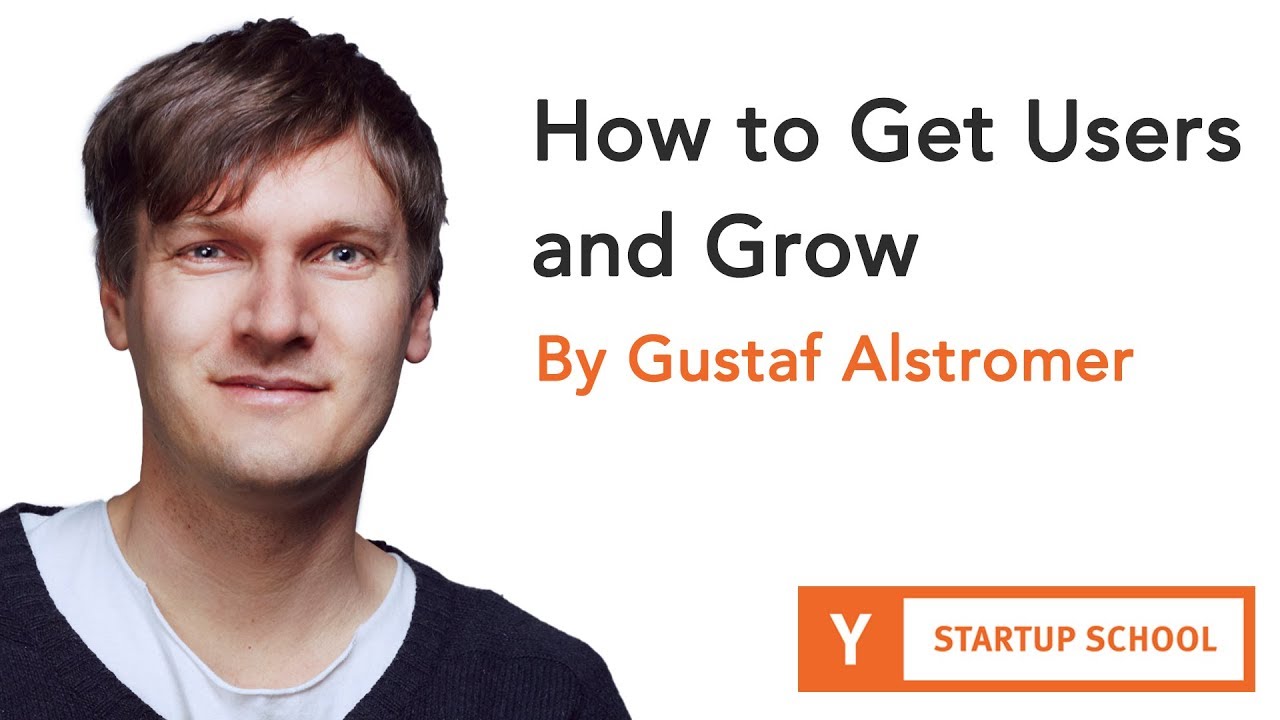
Getting users and growing is its own discipline, not a byproduct of a good product. Gustaf Alstromer on how growth follows retention, how to pick channels that match how your market actually moves, and why founders who skip this optimize the wrong things.
Gustaf Alstromer - How to Get Users and Grow
youtube.com/@ycombinator
12 Sept 2018 · Startups
64 min watch → 95 sec
Growth should start after product-market fit, measured through repeat usage of the product's core value metric. The talk covers retention, funnels, referrals, paid acquisition, SEO, and A/B testing as practical growth tools.
Startups should treat growth as essential only after product-market fit, when users repeatedly return because the product delivers clear value.
Measure fit with one customer-value metric and repeat use at its natural frequency. Retention curves that flatten, not collapse toward zero, justify growth investment.
02 — 20
Product-market fit means users keep coming back because the product solves a real problem.
Growth before that usually creates a spike, then a collapse.
03 — 20
Measure product-market fit with one core value event.
01
Airbnb value is booking and staying.
02
Facebook value is active use.
03
Track repeats at the product's natural cadence.
04 — 20
Cohort retention tracks each week's or month's new users over time.
It measures what percentage repeats the core value action later.
05 — 20
A retention curve that flattens shows product-market fit.
A curve that keeps falling toward zero shows weak fit.
06 — 20
12%
Shopify payment retention after 12 months.
It fell to 10% after one month, then held near that level instead of decaying to zero.
07 — 20
10%
Blue Apron paid retention after 24 months.
It was 50% after one month, then kept declining without a clear plateau.
08 — 20
30%
Netflix paid retention after 7 years.
It was 70% after 12 months, which showed very strong product-market fit.
09 — 20
If a company is too small for reliable retention analysis, founders should talk directly to users.
Ask how they would feel if they could no longer use the product.
10 — 20
Growth is not traditional marketing.
Modern growth changes the product itself, using engineers, product managers, designers, data scientists, and marketers.
11 — 20
Growth comes from two systems.
01
Product-led growth improves conversion inside the product funnel.
02
Scalable acquisition channels bring in more users.
12 — 20
Product-led growth improves funnel steps before the core value moment.
01
Translation.
02
Account creation.
03
Onboarding.
04
Purchase conversion.
13 — 20
Scalable channels depend on user behavior.
01
Search works for infrequent problems.
02
Referrals work when users already share.
03
Sales works when likely customers are listable.
04
Paid ads work when lifetime value supports acquisition cost.
14 — 20
Referrals are engineered word-of-mouth.
Airbnb offered $20 travel credit to the sender and $40 to the new user.
15 — 20
40%
One Airbnb referral share sheet increased shares by 40%.
Changing 'Join Gustav's trip' to 'Accept Gustav's trip invitation' increased signups by 14%.
16 — 20
A/B testing is the reliable way to make growth decisions.
It shows different versions to comparable users at the same time, because intuition is often lucky or wrong.
17 — 20
Paid acquisition should usually wait until the company has revenue.
The test is whether customer acquisition cost is below lifetime value or has acceptable payback.
18 — 20
2.1–2.2 billion
Facebook reached roughly 2.1–2.2 billion users, far above an early 2015 forecast of about 400 million.
Translation, mobile adoption, and internet access work kept raising the ceiling.
Run the company as a build, measure, learn loop: build the simplest version, measure real customer behavior, learn from data, and spend only on making the loop faster. Eric Ries on testing assumptions with little money and judging fit by behavior, not opinion.
Start a Business With No Money | Eric Ries’ Guide for First-Time Founders
youtube.com/@thinkschool
12 Sept 2026 · Startups
66 min watch → 3 min
Eric Ries lays out how first-time founders can start with little money by testing assumptions, measuring real customer behavior, and using engines of growth to judge product-market fit. The discussion covers MVPs, metrics, hiring, trust, and differentiation.
Lean Startup Method
Run a startup as a build, measure, learn loop: build a simple version, measure real customer behavior, learn from data, spend only on making this loop faster
Test whether customers will actually buy, not whether friends say the product sounds good, because a startup idea is a hypothesis made of assumptions
2 / 20
A first-time founder can start with less than $1,000 by renting tools, using AI software, and testing demand before building
Lack of capital can force better decisions than raising money too early
3 / 20
Dropbox validated demand before building the product by releasing a 3-minute screen-recorded demo and collecting 75,000 waitlist signups overnight
4 / 20
To test a consumer product such as coffee, the first question is whether anyone will buy even one cup over existing alternatives such as Starbucks
Not how to build a factory
5 / 20
A minimum viable product can test the real source of differentiation, because what makes a consumer brand win may be mission, design, or quirkiness rather than the founder's original assumption
6 / 20
Tony's Chocolonely validated demand before full production by announcing 5,000 fair-trade chocolate bars and selling 15,000 before the bars even existed
7 / 20
Customer conversations are useful for discovery, generating ideas and hypotheses, but validation requires experiments that measure behavior
Customers often say they would pay and then do not pay
8 / 20
Product-market fit, the state where a product is pulled strongly by real demand, feels like a tornado
Judge progress with per-customer metrics such as repeat purchase, retention, margin, customer acquisition cost, and lifetime value, not vanity metrics like downloads or total users
9 / 20
Track growth metrics instead of vanity metrics for a direct-to-consumer brand
1
Monthly active users instead of app downloads
2
Repeat rate instead of registered users
3
Conversion per post instead of Instagram followers
4
Profit per store instead of store count
10 / 20
Dropbox paid acquisition
$233 to $388
Cost to acquire a customer who paid only $99 per year
Dropbox learned that paid acquisition would not scale
11 / 20
Sustainable growth comes from past customers causing new customers to arrive, and this happens through three engines of growth
Paid growth driven by marginal profit per customer, viral growth driven by a K-factor above 1, and sticky growth driven by low net churn and strong retention
12 / 20
In a paid engine of growth, the key variable is marginal profit per customer
A product sold for $100 that costs $50 to make can fund one new customer for every two sales, while negative marginal profit causes shrinkage
13 / 20
In a viral engine of growth, the key variable is the K-factor, where a K-factor above 1 creates compounding growth and a K-factor below 1 causes the product to fade out
14 / 20
In a sticky engine of growth, repeat purchase and retention matter most, and a useful test is whether customers remember to use the product on their own or need reminders
15 / 20
Selling through marketplaces such as Amazon can hide repeat purchase and churn, so brands need a direct relationship with customers
Improve the direct buying experience instead of treating the business as only selling units
16 / 20
Trust can be a competitive advantage when a company acts as a fiduciary to the customer, putting customer interests first even when costly in the short term
17 / 20
Costco hot dog combo
$1.50
Price held constant since 1986, selling about 200 million per year to reinforce customer trust rather than maximize short-term profit
18 / 20
A real unique value proposition is a promise that competitors cannot honestly make
Such as Tony's Chocolonely's anti-child-slavery mission, Patagonia's environmental honesty, or Costco's customer-first pricing discipline
19 / 20
Read the full source
Start a Business With No Money | Eric Ries’ Guide for First-Time Founders
A business model is the system for how a company creates value, delivers it, makes money, and stays sustainable. Start from the single value customers care about most, then build pricing, delivery, and retention around it so the model is repeatable, scalable, and defensible, not just a product people happen to like.
Designing a Customer-Centric Business Model
youtube.com/@harvardilab
25 Mar 2023 · Business
83 min watch → 1.5 min
A customer-centric business model starts with the single value customers care about most, then builds pricing, delivery, partnerships, and retention around it. The goal is a model that is repeatable, scalable, profitable, and defensible.
A business model is the system for how a company creates value, delivers it, makes money, and stays sustainable over time.
A startup can win through business model innovation, and the strongest models center one exceptional customer need, improve customer outcomes and company economics together, and become RSVP-D: repeatable, scalable, valuable, profitable, defensible.
02 — 20
Four questions define a business model.
01
How do you create value?
02
How do you deliver value?
03
How do you make money?
04
How do you sustain the business?
03 — 20
Startups usually fail because customers do not care enough about the value offered.
Either the problem is too weak, or the opportunity is too small.
04 — 20
Start by choosing what you sell.
01
A product.
02
A service.
03
Software.
04
Content.
05
Data.
05 — 20
Customers usually want an outcome, not the product category itself.
Antivirus buyers wanted protection from viruses, not software.
06 — 20
A customer-centric model starts with the core, one exceptional capability customers most want.
Build the rest of the business model around that need.
07 — 20
When feedback points everywhere, choose a minimum viable segment.
A minimum viable segment is a customer group sharing the same urgent need.
08 — 20
50
percent higher price per seat.
Symantec switched antivirus from boxed retail software to a subscription protection service.
09 — 20
Symantec's business model shift beat better products and eliminated two competitors within a year.
Later, broader data security grew revenue and profit 2.6 times.
10 — 20
TetraScience nearly failed monetizing hardware, then recovered by centering on a biopharma data platform.
The platform normalized instrument data and fit instrument makers and data users.
11 — 20
Product-led growth needs a product that is:
01
Simple to use.
02
Simple to install.
03
Low or no initial cost.
04
Instantly valuable.
05
Easy to fit into existing tools.
12 — 20
Pricing and packaging should reduce friction first, then expand revenue later.
Wistia offered free video hosting, then charged more as storage and tiers grew.
13 — 20
Co-creation strengthens a business model when users or partners help build the product.
Open source communities contribute code, then paid services monetize that ecosystem.
14 — 20
Strategic partnerships matter because most startups provide only one part of the whole solution.
They often need cloud, models, integrations, or distribution partners.
15 — 20
The three ups raise customer lifetime value.
01
Update keeps the product improving.
02
Upgrade moves customers to better versions.
03
Upsell expands what the same customer buys.
16 — 20
A customer journey can be improved at many steps.
01
Recognition and search.
02
Purchase and implementation.
03
Training, testing, rollout.
04
Measurement, optimization, renewal.
17 — 20
The best business models improve customer outcomes and company economics at the same time.
Multipliers raise reach, revenue, or usage. Levers cut time, cost, or resources.
18 — 20
A stronger business model can improve cash efficiency, valuation, founder ownership, and eventual outcome.
The goal is RSVP-D: repeatable, scalable, valuable, profitable, defensible.
Most later-stage problems can wait until fit, then turn urgent around 25 people or 12 to 24 months in. Sam Altman closes with the shift from building a product to building a company: management, alignment, and the founder discipline that fit alone never taught you.
Lecture 20 - Later-stage Advice (Sam Altman)
youtube.com/@ycrootaccess
4 Dec 2014 · Startups
48 min watch → 1.5 min
Later-stage startup success depends on shifting from product building to company building, with simple management, stronger alignment, better HR systems, and founder discipline around focus, burnout, and scaling decisions.
Most later-stage startup problems can wait until product-market fit, when a product strongly satisfies a market, and usually turn urgent around 25 employees or 12 to 24 months.
Around 25 employees, the founder’s job shifts from building a great product to building a great company, and alignment plus self-management become decisive.
02 — 20
A flat startup works until about 20 to 25 employees.
By 30 employees, everyone reporting to the founder often collapses into coordination failure.
03 — 20
A scaling startup needs one simple rule.
Every employee has exactly one manager, and every manager knows their direct reports.
04 — 20
Around 25 employees, founders must become company builders.
Many fail by not adapting to hiring, delegation, management, and organizational design.
05 — 20
Waiting too long to hire senior executives is a common founder mistake.
Experienced leaders can take over major functions, and founders usually wish they hired earlier.
06 — 20
Hero mode burns managers out.
Accept 2 or 3 weeks of slippage, then hire ahead of growth instead of absorbing everything personally.
07 — 20
Delegation works only when employees own decisions.
If smart people only gather data for the founder, the founder becomes the bottleneck.
08 — 20
Alignment drives productivity as headcount grows.
01
Repeat clear goals.
02
Repeat the roadmap.
03
Repeat company values.
04
Keep weekly and monthly communication rhythms.
05
Make top priorities identical across employees.
09 — 20
Square of headcount
Productivity tends to fall at this rate without systems.
Each new pair of people adds communication overhead.
10 — 20
A useful communication rhythm has 3 parts.
01
Weekly meeting for the CEO’s direct reports.
02
All-hands at least once a month.
03
Quarterly plan tied to annual goals.
11 — 20
Informal memory stops working as coordination load rises.
Founders need a personal system for long-term goals, daily priorities, follow-ups, and each person’s work.
12 — 20
Written operating rules and cultural values scale better than oral tradition.
Writing them down becomes high leverage by 100 or 1,000 employees.
13 — 20
Good HR around 25 to 45 employees means structure, not bureaucracy.
01
Clear reporting structure.
02
Career paths.
03
Frequent performance feedback.
04
Compensation bands.
14 — 20
Compensation bands prevent fairness crises.
Defined ranges for mid-level and senior engineers reduce chaotic one-off salary negotiations.
15 — 20
Employees should keep getting substantial equity, including refresher grants.
Founders should expect to grant roughly 3 to 5% of the company per year for about 10 years.
16 — 20
An option management system should replace Excel once the company scales.
Stock administration mistakes have cost companies and employees tens of millions of dollars.
17 — 20
Two people risks appear early in scaling.
01
At 50 employees, new HR compliance rules begin.
02
Diversity needs attention before later-stage issues.
03
A monoculture from the first 15 or 20 hires is hard to change.
18 — 20
Founders need self-management for a long journey.
Avoid acquisition talks unless you would truly sell for a relatively low number, because distraction kills momentum.
Fit is the moment your product starts pulling instead of you pushing. But pull is not a company. Every talk here points at the same gap: the founders who stall after PMF are almost never stalled on the product. They are stalled on distribution that never matched the market, on prices set from fear instead of value, or on a model that was never built to scale in the first place.
Treat PMF as the day the real work starts, not the day it ends. Save the carousels worth revisiting, and when one earns your full attention, the original talk is linked under it.