Building a software company used to need a team of ten to thirty people and a round of funding before it could serve anyone. That floor has dropped. AI tools now let a single founder build, sell, and run a product for a niche of a few hundred customers, and solo-founded startups have climbed from under a quarter of new starts to more than a third. The pattern across these talks and essays is that the constraint is no longer headcount, it is judgment: which problem to solve, how few customers you actually need, where to pull leverage, and which features to refuse so one person can carry the whole thing for years. This collection walks that arc, from the thesis that one founder is now enough, to a working system that got there, to the shape of a business built as a cash machine, to leverage as the operating principle, to standing cost as the discipline that keeps it maintainable, to anti-scale as a legitimate finish line.
For most of software’s history, building a company meant hiring a team and raising money before you could serve a single customer. AI has moved that floor. One founder with product or technical skill can now build, sell, and operate a real software business for a niche of a few hundred people, and the hard part is no longer capacity, it is choosing well: the right problem, the fewest customers you need, the leverage worth pulling, and the features worth refusing. Below is the arc as carousels, core claims first, with a link to the full talk or essay under each.
One founder is now enough
AI lets a single founder build a software business for a niche of 500 to 1,000 customers, work that not long ago needed ten to thirty developers and millions of dollars. As AI makes both software and content cheap to produce, they turn into commodities, so the durable move is to pair a simple tool with a community and a specific expertise that is hard to copy. The scarce input shifts from engineering capacity to taste and distribution.
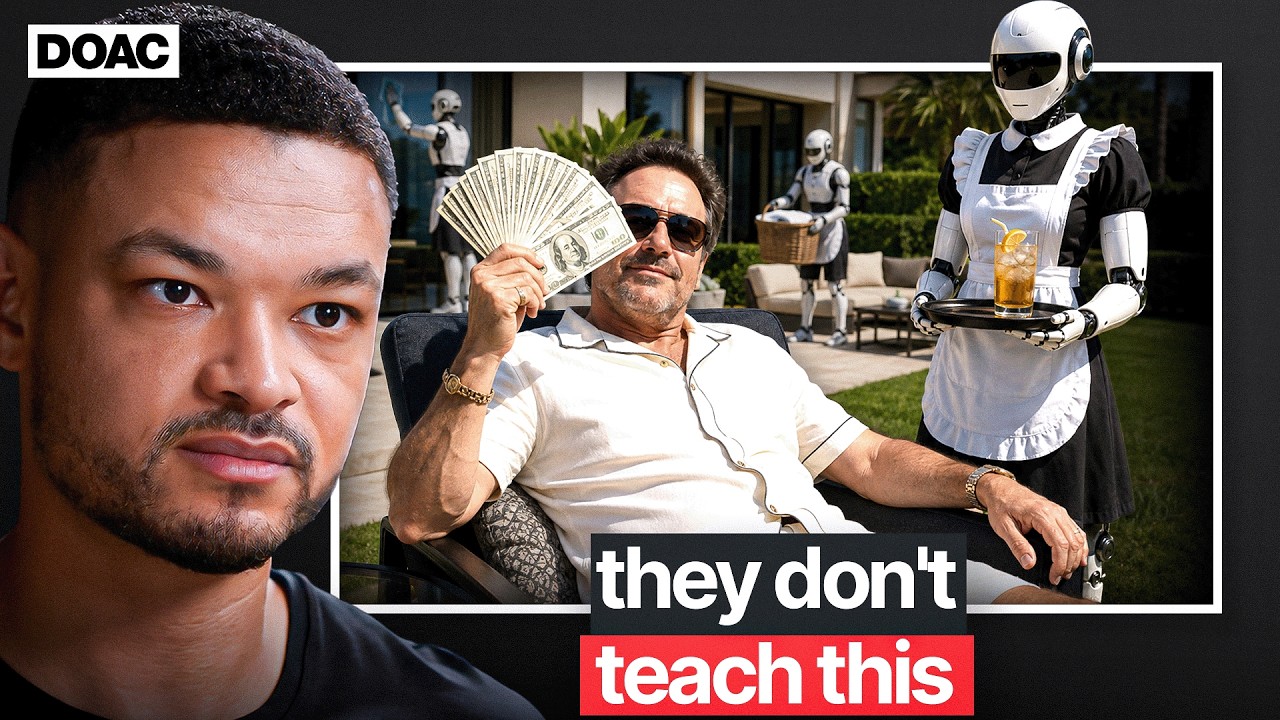
The EASIEST Way To Make Money With AI (Copy This)
youtube.com/@thediaryofaceoclips
3 Sept 2026 · Business
24 min watch → 3 min
AI is lowering the cost of building software and content, which makes both easier to copy. The stronger opportunity is to build small businesses around niche tools, personal expertise, community, and human experiences that AI cannot replicate.
Building in the AI era
AI lets one founder build a software-as-a-service business for a niche of 500 to 1,000 customers, work that once needed 10 to 30 developers and millions of dollars
Software and content become commodities as AI makes them cheap, so pair a simple tool with community, training, or events that are harder to copy
02 / 20
A software-as-a-service company sells software on subscription, and AI now lets founders turn their own expertise into a playbook and create an early product for almost no money
Ask AI what software to build from your playbook, and it can generate the product
03 / 20
One company rebuilt its applicant tracking system in about a week after paying tens of thousands of dollars per year for one
An applicant tracking system stores candidates and tracks where they are in the hiring process
04 / 20
The rebuilt system was better because it was bespoke, meaning custom-built for one company's exact workflow instead of designed for a generic market
05 / 20
Speed of disruption
1 week
Time to build a product that once cost $500,000 and took 6 to 18 months
Many competitors can launch similar products just as quickly
06 / 20
The same force that makes content and software easier to create also reduces their value
When everyone can produce them without much cost, competition rises and margins fall
07 / 20
Software becomes more valuable when it includes more than productivity
01
Education and a method
02
Boot camps and training
03
Dinners, retreats, and events
04
Funding access or other community benefits
08 / 20
Real-world experiences remain more defensible than pure software or pure content
An AI system cannot physically attend an event, host a dinner, or give face-to-face reassurance
09 / 20
Blue Ocean Strategy distinguishes red oceans, crowded markets where competitors look interchangeable, from blue oceans, uncontested markets with room to grow
AI shortens the life of blue oceans because successful ideas can be copied in months instead of years
10 / 20
A social media agency was a blue ocean around 2014, but by 2024 many founders were running agencies and large firms faced margin pressure
Marketing agencies illustrate how AI compresses the window before a new idea becomes crowded
11 / 20
It is easier than ever to build a small successful business with $1 million to $5 million in revenue and about 10 people
But harder than ever to build a large business because AI speeds up disruption and competition
12 / 20
The most defensible business asset in an AI world is personal intellectual property, meaning lived experience, personal playbooks, and stories that only one human can credibly share
13 / 20
Relatable beats impressive in audience building, because people connect more strongly with honest human experience than with status signals such as being a billionaire CEO
14 / 20
Streamers build stronger parasocial relationships, meaning one-sided audience bonds that feel like friendship, because they interact live and share ordinary experiences
They make viewers feel personally included
15 / 20
A financial planner named Matt Pitcher found a unique story in having met 100 British lottery winners through a lottery partnership
A TED talk about that experience reached about half a million views in its first few weeks
16 / 20
AI can help turn personal playbooks into products, but the starting point is still a human's own quantified experiences, methods, triumphs, and failures
AI has data and knowledge but no lived experience
17 / 20
£50,000 to £20/mo
Cost drop for one legal dispute handled with Claude instead of a law firm
Used negotiation guidance, decision trees, documents, and spreadsheets
18 / 20
A durable AI-era business is an ecosystem, not one offer
Unique personal knowledge attracts a community, that combination creates a personal brand, and that brand can be productized into multiple products and services
The thesis is not hypothetical. This founder built and ran multi-million-dollar software alone, and lays out the exact path: solve your own problem first, test demand with an audience before you build much, then launch a minimal product and let feedback pull the roadmap. The system is deliberately small on purpose, because a single person can only carry so many moving parts and still move fast.
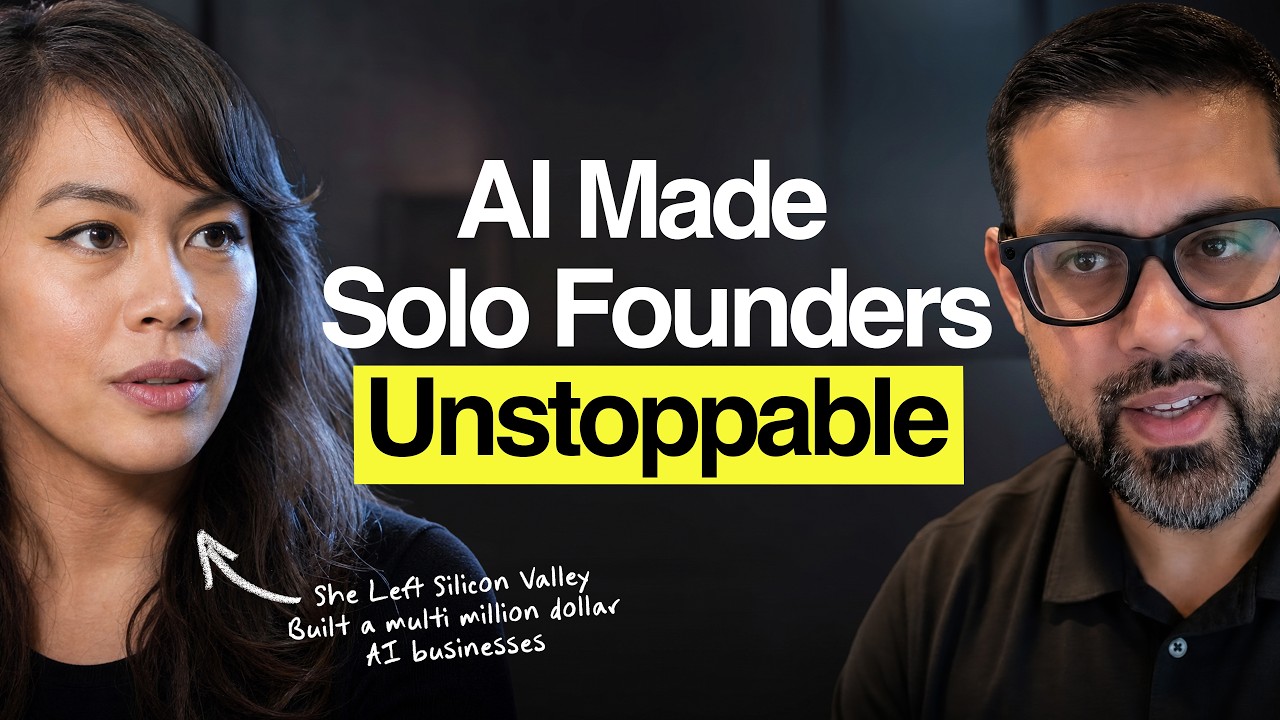
She Built Two AI Businesses Solo, Here's the exact System
youtube.com/@productfaculty
23 Aug 2026 · Startups
46 min watch → 3.5 min
A solo founder describes how she validated an AI software idea, launched a minimal product, used audience-driven distribution, and grew from zero to millions in annual recurring revenue with heavy use of AI tools and automation.
Solo founder playbook
AI tools let a solo founder with product or technical skill build and run a multi-million-dollar software business without raising capital or hiring a team first
The fastest path is to solve your own problem, test demand with audience feedback, and launch a minimal viable product, a stripped-down first version, before adding features
02 / 20
A personal brand or distribution channel, an audience that already trusts your expertise, acts as a cheat code for customer acquisition
It sends a constant flow of new users and feedback for product improvement
03 / 20
Vibe coding, using AI to generate much of the first version of a product, is best for validating an idea and getting the first 10 to 100 paying customers
It is not for replacing engineering judgment in a mature product
04 / 20
Bootstrapping a small software business to $1 million to $2 million a year creates cash flow and optionality
You can stay independent or raise funding later if you want to grow bigger
05 / 20
The product idea came from a real workflow pain point, repurposing one piece of content across platforms
Repeated audience comments asked for an app instead of fragile make.com automations
06 / 20
Demand validation started with a 30-second TikTok posted on August 1, 2024, asking whether people wanted a software-as-a-service tool that could repurpose content and automate social posting
The tool was aimed at small businesses
07 / 20
Comments and survey responses were not enough to trust, so direct phone calls with 10 to 20 commenters were used to learn what tools people already used and what they paid for
The calls revealed where the new product would fit in their workflow
08 / 20
The first product version succeeded because it was aggressively pruned, for example generating only a Facebook post instead of supporting LinkedIn, Twitter, and Facebook at once
That basic version still reached the first $10,000 in monthly recurring revenue
09 / 20
Launch velocity
10 days
Time from launch on October 20 to reaching the first $10,000 in monthly recurring revenue
An existing audience and a waitlist with hundreds of interested people accelerated growth
10 / 20
An early adopter program with about 50 selected users slowed progress because self-reported use cases did not match actual behavior
PostHog session recordings confirmed this say-do gap
11 / 20
Watching user session recordings was the most useful early product research because it showed where people rage-clicked, got stuck in payments, and failed onboarding
This happened before formal dashboards or funnels were set up
12 / 20
Changing onboarding from a blank interface to a step-by-step flow improved activation because users reached value faster
01
Paste a link to your content
02
Choose up to five platforms
03
Get draft posts immediately
04
Users see value before exploring settings
13 / 20
Early churn reality
Over 30%
Estimated early churn rate, but constant new signups from existing distribution made it possible to keep improving onboarding and activation
Growth did not stop, so the team could iterate instead of panicking
14 / 20
AI-generated code still requires a human architect because unchecked code can introduce spaghetti code, break production systems, and make hidden changes
The workflow shifts from 100% vibe coding to AI-assisted coding with human specs and review
15 / 20
Building an MVP used to cost about $5,000 to $15,000 and take three to six months, but AI compressed both time and cost
The MVP took less time to build than the YouTube videos documenting it
16 / 20
TikTok was recommended as the best starting platform for new creators because it is unusually generous to new accounts
Posting once a day for 3 to 4 weeks, then 3 times a day, led to the first viral growth after about 6 weeks
17 / 20
The most reliable content strategy was to copy proven hooks and post structures from top-performing creators in the same niche
The opener determines whether people stop scrolling
18 / 20
Content creation was systematized into one day a week, with one long-form video and about 20 short videos
That schedule supported growth from zero to $2 million before adding a second day to reach $3 million
19 / 20
Read the full source
She Built Two AI Businesses Solo, Here's the exact System
A self-funded software business works best as a predictable cash machine, recurring monthly profit rather than a bet on a distant exit. Jason Cohen’s math is concrete: roughly 150 customers paying about $70 a month is a real business, and annual prepay solves the cash-flow problem that sinks most bootstrappers. The reframe matters for a solo founder, because you are optimizing for durable monthly profit per person, not for a valuation.
Designing the Ideal Bootstrapped Business with Jason Cohen
youtube.com/@robwalling
4 Dec 2019 · Startups
66 min watch → 1.5 min
A self-funded software business works best when it sells recurring B2B value at high enough prices, uses annual prepay to solve cash flow, and chooses markets with ongoing pain and repeatable acquisition.
A self-funded startup works best as a cash machine, producing predictable recurring monthly profit, with at least $10,000 in monthly revenue per founder.
The strongest fit is about 150 customers paying roughly $70 per month, and recurring revenue plus annual prepay beat one-time sales for cash flow.
02 / 20
1,000 paying customers is not a simple path for a self-funded startup.
Even $200,000 a year may not cover a small operation's real costs.
03 / 20
Charging too little forces a self-funded startup to chase thousands of customers.
Higher prices, tiering, coupons, and boutique positioning can push average revenue above $100 per month.
04 / 20
A boutique software business can charge premium prices.
Customers pay more for specialized work, personal attention, and supporting a small independent company.
05 / 20
$49, $99, $249
WP Engine pricing tiers produced more than $100 average monthly revenue per customer.
That made the business viable with far fewer customers.
06 / 20
Recurring revenue beats one-time software sales for self-funded companies.
One-off sales restart revenue from zero every month and create constant cash-flow stress.
07 / 20
Annual prepay is a core cash-flow tool for self-funded software.
If acquisition costs $300 and monthly price is $50, discounted annual plans can return cash immediately.
08 / 20
25%
At WP Engine, about 25% of new revenue came from annual prepay.
That produced more than 3 times first-month cash flow versus monthly billing.
09 / 20
Free trials often hurt self-funded software companies.
A 60-day money-back guarantee collects cash sooner than giving 15 to 30 free days.
10 / 20
At WP Engine, replacing a 15-day free trial with a 60-day money-back guarantee coincided with a signup jump.
Adjusting tiers and adding a business plan happened at the same time.
11 / 20
The best self-funded markets share 4 traits.
01
They sell business-to-business.
02
They solve ongoing pain.
03
Customers will pay enough.
04
Acquisition is repeatable.
12 / 20
Good recurring markets include these categories.
01
Hosting and invoicing recur through operations.
02
Taxes, reporting, and compliance recur.
03
SEO and AdWords management recur.
04
Email marketing and A/B testing recur.
13 / 20
These markets fit self-funding poorly.
01
Consumer software buyers resist paying enough.
02
Temporary-event products lack recurring need.
03
Real-time products create operational burden.
04
Marketplaces require buyers and sellers.
05
Low-take-rate models leave little margin.
14 / 20
Aftermarket products can be strong self-funded businesses.
Tools built on WordPress, Basecamp, QuickBooks, Salesforce, or Heroku inherit existing customers, use cases, and channels.
15 / 20
Big markets are better than tiny markets for self-funded startups.
They offer more niches, more repositioning room, and enough demand for several winners.
16 / 20
Social media is an unreliable primary acquisition channel for a self-funded startup.
Paid acquisition can start near one twenty-fifth of average monthly revenue per customer per click.
17 / 20
Affiliate programs can work well for self-funded software.
They work best when prices support meaningful commissions and annual prepay offsets the cash outflow.
18 / 20
Growth forces a choice between a small profitable business, a larger managed company, and a venture-scale path.
Founders should decide before hiring, management, or a sale makes the choice for them.
19 / 20
Read the full source
Designing the Ideal Bootstrapped Business with Jason Cohen
One-person businesses grow by finding a few leverage points and pulling them hard, not by adding team members, products, and channels. Justin Welsh frames leverage as the cheat code: repurpose one piece of work across many surfaces, run one offer to one audience, and lean on distribution instead of headcount. Every new axis of complexity is a tax a solo operator pays in attention, so the discipline is to add leverage, not surface area.
Leverage is the solopreneur cheat code.
justinwelsh.me
20 Sept 2025 · Business
A solopreneur growth strategy built on leverage, repurposed content, selective work, story-based selling, and heavy distribution. The approach favors one offer, one audience, and focused channels over complexity.
One-person businesses grow by finding a few leverage points and pulling them hard
Not by adding more team members, products, and channels
2 / 15
$10.5M+
generated as a solopreneur through leverage, not complexity
3 / 15
A simpler path compounds faster
Start with one offer for one specific group and one channel until it works
4 / 15
Distribution beats product quality alone
A good product seen by 100,000 people will outsell a great product discovered by 500
Content scales better when one idea follows the 5-12-3 rule
Works in 5 seconds, stays relevant 12 months later, functions across at least 3 platforms
7 / 15
One idea can be turned into content for X, LinkedIn, Instagram, Threads, and Substack over four days with zero additional creative work
8 / 15
A best-performing post from 2024 still generates leads because evergreen, repurposed content becomes an asset instead of a one-time output
9 / 15
Time has two price tags
Low-value tasks should be outsourced so those hours can be reinvested into strategy, product improvement, and creation
10 / 15
Admin tasks and customer support can be outsourced for $30 per hour, while hours spent on strategy or product improvement can generate $1,000+ per hour in value
11 / 15
Paying $300 for a permanent fix to a recurring payment software issue freed up time that was used to create newsletters and content that added five or six-figures to the business
12 / 15
Selective work produces better outcomes
Turning down a $100,000 consulting offer led to accepting a $40,000 project with complete creative control, async work, and a problem worth solving
13 / 15
Story-driven positioning sold The Creator MBA at a 5x higher price than other course products
6,500+ entrepreneurs bought it because the narrative created recognition before listing features
Standing cost is the discipline that keeps it alive
For a solo developer, a feature’s real cost is its standing cost, not its build cost. Every feature you ship comes with recurring maintenance, support, re-testing, and review risk that one person carries forever. The practical rule is to default to no, judge each idea by its lifetime burden rather than its build time, and keep a written list of the features you refused. This is what lets a one-person product stay maintainable for years instead of collapsing under its own surface area.
Every feature I add, I maintain alone forever. So I stopped.
dev.to
28 Aug 2026 · Business
7 min read → 2 min
A solo iOS developer argues that new features should be judged by their lifetime maintenance burden, not their build time. The piece proposes defaulting to no, using a standing-cost test, and keeping a written list of refused features.
For a solo developer, a feature's real cost is its standing cost, not its build cost
Every feature ships with recurring maintenance, support, re-testing, and review risk that one person owns alone forever
02 / 18
003
The day a feature ships is the cheapest day that feature will ever have
Every day after adds recurring maintenance that one person owns alone forever
03 / 18
004
Feature-first advice was minted inside teams, where ownership cost is quiet and distributed across support, QA, on-call, and backlog roles
A solo developer is every seat in that room at once
04 / 18
The cost split is build versus standing cost:
INDEX
001
Code becomes re-read and re-tested every OS beta
002
Support becomes edge-case emails
003
Interface becomes more to explain and keep consistent
004
Attention gets divided
005
Each feature adds Apple review risk
05 / 18
006
Some features took two days to build and then quietly taxed a full year
Refusing a two-day feature can save that same year without any visible signal
06 / 18
007
Solo developers should make no the default, and a feature should earn a yes against its standing cost rather than its build cost
07 / 18
Would I still want this if I had to maintain it, alone, through the next three iOS versions, and it brought in no new users at all?
08 / 18
009
Skipping folders and tags avoided teaching users a filing system, kept the settings screen to one page with six toggles, and prevented emails about notes lost in folders
09 / 18
010
Skipping cross-device account sync avoided accounts, a server, conflict resolution, a privacy surface, and 2am support problems that one person cannot staff
10 / 18
011
Turning down rich text, themes, and a home-screen widget with live counts kept the app's failure modes bounded by how few things it does
11 / 18
012
A written no list works better than a roadmap for a solo app
It records declined debts, speeds consistent refusals, and only repeated requests move to a shorter maybe list
12 / 18
013
Some refusals were avoidance rather than discipline, including a feature delayed for two releases because it touched an intimidating part of iOS
13 / 18
014
Refusing too much can make a product stop being alive
Subtraction is a tool, not a personality. A codebase can die from too many features or from an owner who loves saying no
14 / 18
015
A clear no loses some users, but it ages better than silence or great idea, on the roadmap that never arrives
15 / 18
016
Do one thing well only works if the narrow core is genuinely good
Otherwise the product is unfinished rather than focused
16 / 18
017
An app that does less than most competitors can remain maintainable by one person after fifteen months, and those two facts are linked
17 / 18
Read the full source
Every feature I add, I maintain alone forever. So I stopped.
Scaling raises revenue, but it also raises team size, overhead, stress, and problems you never wanted. A solo or small business at $300K to $1M a year can already fund a good life, savings, and freedom, so growth past that point is a choice, not an obligation. For a one-person company, staying deliberately small is not settling, it is the design goal that preserves the time and flexibility the whole model exists to protect.
The case for anti-scale.
justinwelsh.me
6 Dec 2025 · Business
Small businesses do not have to scale once they reach a profitable size. Higher revenue often brings more overhead, management, and stress, while staying small can preserve time, flexibility, and long-term wealth.
Anti-Scale
Scaling increases revenue, but also team size, overhead, stress, and problems you never wanted to solve
A solo or small business at $300K to $1M a year can already fund a good life, savings, and freedom without the complexity
02 / 12
003
Two solo entrepreneurs, one making $1.3M a year as an AI consultant and one making $900K in AEO, were stressed because they thought they should already be much bigger
The pressure to scale came from wanting to impress others, not from any gap in their own lives
03 / 12
004
Writing a job posting for a Chief of Staff exposed the truth: adding hires would mainly create complexity that then needed to be managed
04 / 12
005
Staying small preserves autonomy. You can change direction, take risks, run experiments, and stop working offers without layoffs, buy-in meetings, or concern for employees' livelihoods
05 / 12
Case study
$1.5M
Revenue held steady for 8 years at a small design agency
Owner works 4 days a week, takes 6 weeks off every year, pays two part-time employees well enough to keep them for years
06 / 12
007
That agency owner takes home $700K a year after paying everyone and covering expenses, saves a large share, invests regularly in the stock market, and is on track to retire in his early fifties
07 / 12
008
Scaling that agency from $1.5M to $3M would require 3 or 4 more people, including full-time designers, and would likely raise net income only from $700K to $850K
An extra $150K is not worth longer weeks, more meetings, and spending time on personnel issues instead of design work
08 / 12
009
The real trade in scaling is not money left on the table. It is whether the extra profit is worth longer weeks and a shift from doing the work to managing people
09 / 12
010
A business can create more long-term wealth by holding a profitable size for 15 or 20 years, working less, saving more, and investing consistently, instead of chasing growth
10 / 12
When a business stays small, financial stability lets you: